
Does biomechanics help with crossbite?
Yes in my view it does and i'll explain why.

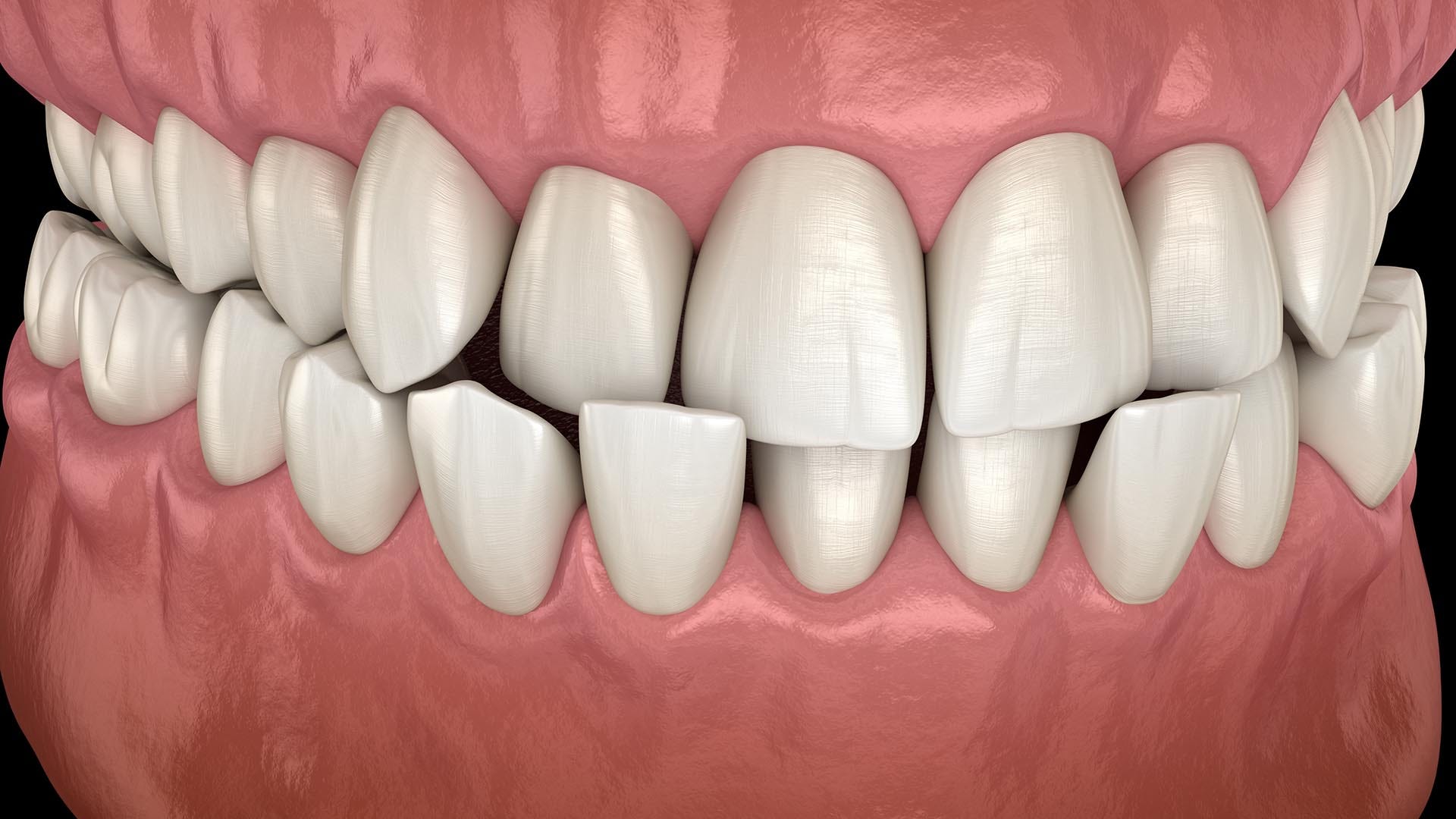
A common question that I get asked is whether Reviv helps with crossbite.
And in my view it does.
But today I want to dive into this topic a bit better to understand what crossbite is, why traditional dental methods fall short, and why yet again Reviv succeeds where those dentists failed.
What is crossbite?
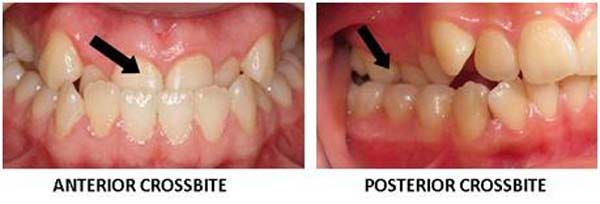
Crossbite is a type of dental malocclusion where the upper teeth fit behind or inside the lower teeth when the mouth is closed.
Unlike a normal bite pattern where upper teeth sit slightly outside the lower teeth, crossbite is a misalignment in which the upper teeth are inside the lower teeth.
Crossbites can be classified into two main types:
Anterior crossbite: Where the front upper teeth sit behind the lower front teeth
Posterior crossbite: Where the back upper teeth sit inside the lower back teeth
This condition can affect a single tooth or groups of teeth and may be unilateral (affecting one side) or bilateral (affecting both sides).
Common theory is that crossbites develop due to various factors including genetics, jaw development issues, prolonged thumb-sucking, delayed loss of baby teeth, or breathing problems that affect jaw growth.
And dentists like to warn that if left untreated, crossbites can lead to uneven jaw growth, facial asymmetry, accelerated tooth wear, gum recession, and even temporomandibular joint (TMJ) disorders.
How do dentists typically treat it?
Conventional dental approaches to crossbite focus primarily on mechanical repositioning of teeth and jaws, often missing the underlying biomechanical causes:
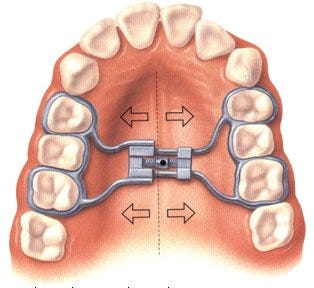
Palatal expanders: These devices are attached to the upper teeth and roof of the mouth to gradually widen the upper jaw. Studies suggest that 70-80% of children with posterior crossbites receive this treatment.
Braces or clear aligners: Used to reposition individual teeth into proper alignment, often following expansion.
Reverse-pull headgear: For anterior crossbites, this applies forward pressure to bring the upper jaw forward.
Surgical interventions: In severe adult cases, jaw surgery (maxillary osteotomy) may be recommended to reposition the upper jaw.
But does it work?
Let’s first look at what the official records say about the success rates of traditional crossbite treatments:
Palatal expanders show an initial success rate of 80-90% in children, but relapse rates range from 20-45% according to long-term studies.
Adult treatments generally show lower success rates, with mechanical expansion methods often requiring surgical assistance.
So even according to the ‘official’ reporting these treatments fail almost half the time.
And I have a feeling failure is being massively under-reported because they are only paying attention to the teeth.
Is it really a ‘success’ if the person’s teeth stay out of crossbite, but the person’s face and posture dramatically change for the worse?
In my book absolutely not. That is still a FAIL.
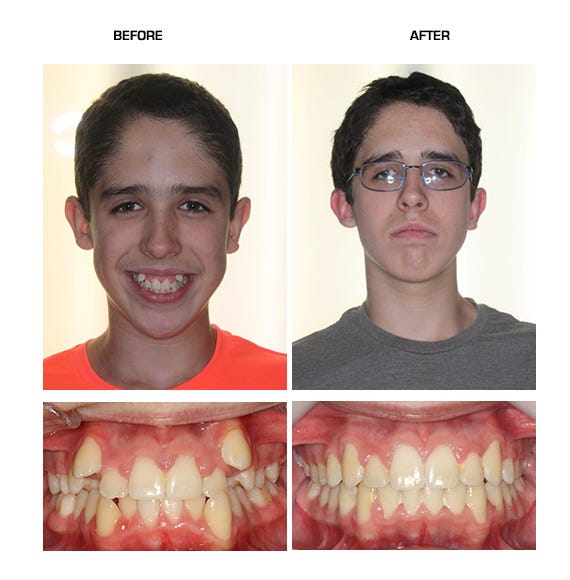
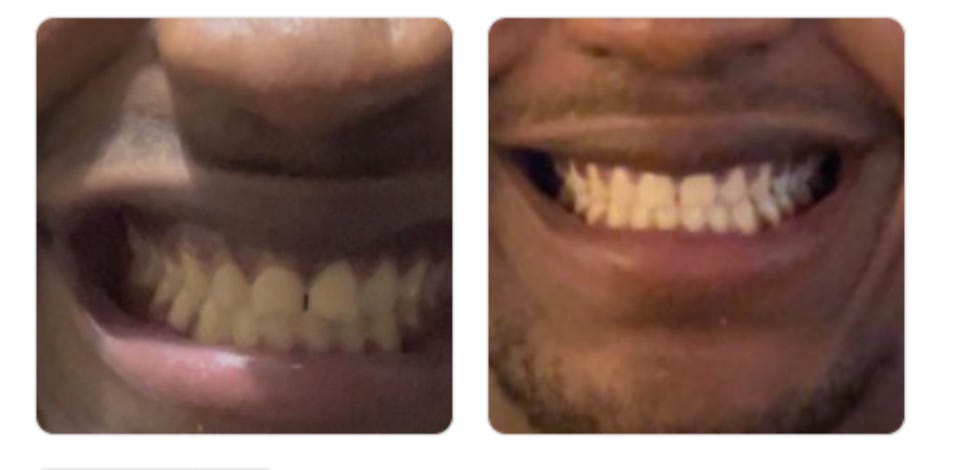
This kid above is a perfect example of how orthodontics fails.
Does the kid’s teeth look straighter after? Yes!
Does the kid look healthier and happier after? Hell no! He radiates far more happiness before.
And so my suspicion is that obvious failure is up around 80-90% (ie. skull/body/health clearly got worse) and true failure is a full 100% (ie. literally everyone got at least a little worse).
How am I so confident? Let me explain.
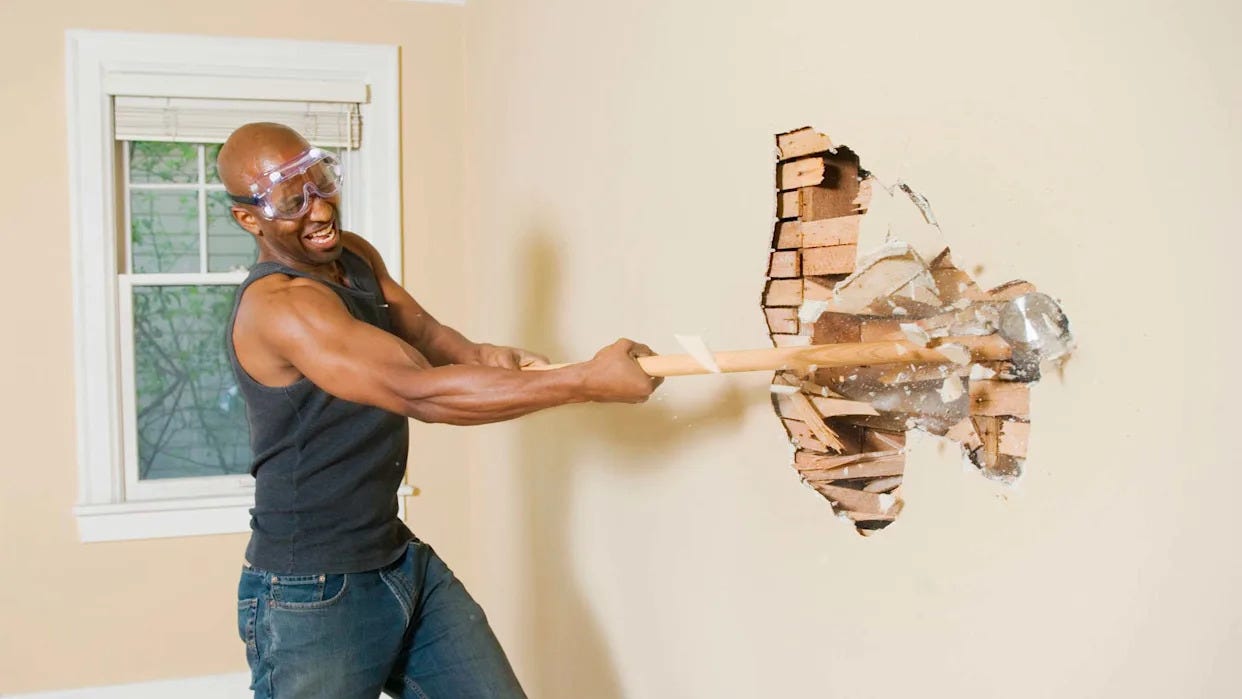
Why I think those methods are wrong?
The conventional approach to treating crossbite fundamentally misses the underlying biomechanical foundation.
One of my favorite quotes is “the teeth are always exactly where the skull wants them to be UNLESS a dentist unnaturally moves them.”
And so even if the teeth are in crossbite they are there because the skull put them there for stability purposes. Because the jaw needs support with the cusps of the teeth in both retrusion and protrusion as I wrote here:

So even though it may not look pretty that the teeth are in crossbite, the skull has put them there to prevent faster collapse.
And when a dentist moves them out of that position with something like an expander… they are basically taking a sledgehammer to the skull’s stability and it will ‘deflate’ as I like to say.
So what is the right way to treat crossbite?
I’m going to sound like a broken record at this point but you do it the same exact way that you fix pretty much any other maloclussion in my view.
You do it by not focusing on the teeth at all and rather focusing on the skull.
And you do that by wearing a mouthguard like a Reviv plus doing stretches like my ‘fast method’.
The mouthguard acts as a sort of doorjam between the jaw and the skull that doesn’t allow the jaw to fully close and stretches the soft tissue I talk about.
As the soft tissue stretches, the skull ‘inflates’ like a balloon. The cranial bones move outward and into better symmetry over time, which ends up widening the palate naturally.
The jaw moves into a healthier position.
And the teeth ‘go for the ride’ as I like to say. Meaning they follow how the skull evolves and align better and better over time.

Closing thoughts
There is a fundamental difference between my approach and the approach of dentists, which I like to coin as ‘respect’.
You see I respect the body’s intelligence. It’s ability to compensate to survive.
I do not think that I am smarter than the body because I know that at the end of the day the body is getting far more direct inputs than I am about how it is functioning.
And this is exactly the mindset you need to reverse crossbite in my view. Give the body the right biomechanics it needs to heal itself and then let it take over.
We have a number of people in our community that have pretty much fixed crossbite or are well on their way.
And they are achieving this typically after many dentists charged them a lot of money, made a lot of promises, and then failed.
But now unfortunately for these dentists we are going to make a laughing stock out of them as we show just how cheap and easy it is to fix your crossbite on your own.
Suppose a person of advanced years wore the Reviv to correct an overbite - or underbite: would there be any correction or is it too late?
Two of my children have just started Invisalign treatment for crowded teeth and cross bite. What would your recommendation be?